
The Dublin Dons That Never Were: How Close Wimbledon Came to Changing Football Forever


Real Madrid loanee scores first career hat-trick in stunning Lyon debut
Sometimes the most fascinating stories in football are the ones that never actually happened. The Dublin Dons plot is one of them.
A Club Without a Home and a City Without a Team
Wimbledon's problem in the mid-1990s was simple. They were an established Premier League side with no permanent home of their own. Ground-sharing with Crystal Palace at Selhurst Park was a mess for everyone involved. Palace fans made no secret of their disdain for the tenants. Wimbledon's board knew it couldn't last.
What happened next reads like a fever dream. A Ticketmaster executive in Dublin picked up a Sunday paper, read about Wimbledon chairman Sam Hammam's planning disputes with Merton Council, and connected two dots that nobody else had bothered to join. There was a 40,000-seater stadium with planning permission on the outskirts of Dublin and a Premier League club desperate for somewhere to call home.
The consortium that eventually formed around this idea was straight out of a film. A property developer, a businessman, a sharp-tongued television pundit in Eamon Dunphy, and the manager of U2. If that group can't sell a concept, nobody can.
What the Premier League Could Have Looked Like
The bid they put together was £6 million for 74% of Wimbledon. They were sat in the crowd at Selhurst Park on the opening day of the 1996-97 season, the same afternoon David Beckham lobbed Neil Sullivan from the halfway line in one of the most replayed moments in Premier League history, finalising their approach.
Kenny Cunningham, the Dublin-born full-back who was playing for Wimbledon at the time, says his English teammates thought Dublin was somewhere on the other side of the world. He was busy telling them they were going to love it.
Hammam himself seemed genuinely interested. Wimbledon were always a club that thrived on chaos and publicity, and the idea of a Premier League club playing fortnightly in Dublin was exactly the kind of bold swing Hammam enjoyed. Joe Kinnear, the manager at the time, told Cunningham it was serious.
Think about what the league looked like then. Klinsmann had already come and gone. Bergkamp and Zola were arriving. The Premier League was starting to grow its international appeal in ways nobody had fully mapped yet. A club based in Dublin would have been a permanent fixture in the Irish consciousness, not just a summer friendly. Manchester United drawing 75,000 to Croke Park in 2025 is remarkable. Wimbledon playing league football in Dublin every other Saturday would have been a different kind of history entirely.
Why It Fell Apart and Who Paid the Price
The FAI killed it before it could breathe. Their concern was that a Premier League club in Dublin would destroy the League of Ireland, and on that point they probably weren't wrong. The domestic game would have struggled to compete. What the FAI missed, and Tommy Higgins has been saying this ever since, is that the rising tide might have lifted all boats. Irish football could have used that kind of platform.
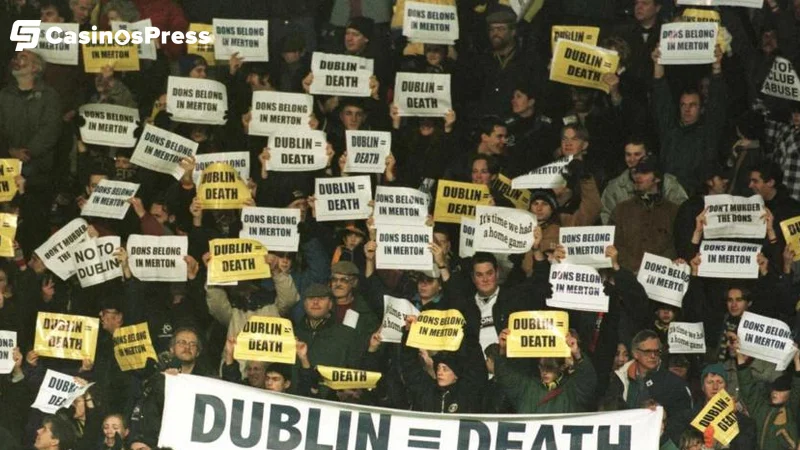
Wimbledon fans had no interest in any of it. Ivor Heller, who had followed the club since their non-league days and later co-founded AFC Wimbledon, was blunt about it. He helped produce the 'Dublin = Death' placards that appeared at Selhurst Park. From where he was standing, a move to Dublin wasn't salvation. It was the end of the club.
In the end, Hammam simply stopped answering. Calls went unanswered, letters unreturned. The consortium found out through an airport television screen that he had sold 80% of the club to a pair of Norwegian businessmen for £26 million, more than four times their offer. The unsigned contract still sits in Higgins's files.
The stadium site became a shopping centre. Wimbledon eventually got moved to Milton Keynes anyway, which is the outcome everyone was trying to avoid.
What This Story Actually Tells Us About Football
Wimbledon's brief flirtation with becoming a Dublin-based Premier League club is worth revisiting not just as a curiosity but because of what it reveals about how football makes decisions. The FAI looked at the short-term threat and blinked. Hammam played his cards privately and walked away with a better deal. The fans who cared most about identity had no real seat at the table.
The football itself sorted out the rest. AFC Wimbledon were born in the ninth tier in 2004 and have since climbed back to League One, playing once again at Plough Lane. Cunningham calls that the greatest achievement in the club's history, and it's hard to argue.
As for the Dublin idea, it remains one of the great what-ifs of the Premier League era. Higgins still believes it would have worked. Given how Irish fans continue to pack out English grounds every weekend and fill Croke Park for summer friendlies, it's genuinely difficult to say he's wrong.
Editorial Note: Marcus Osei
Senior football writer and tactical analyst with 12+ years covering the Premier League, Champions League, and world football. Born in Accra, raised between London and Kuala Lumpur.