
Infantino on the Ropes: Can Fifa’s Most Powerful Man Survive His Own Rebellion?


Real Madrid loanee scores first career hat-trick in stunning Lyon debut
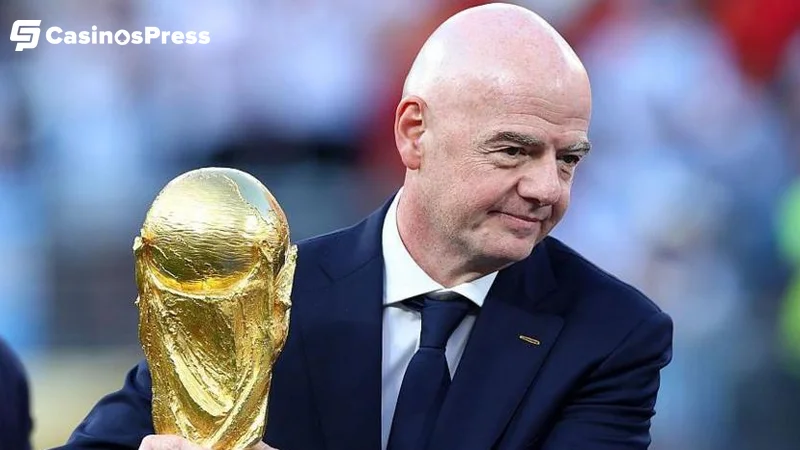
Gianni Infantino has run Fifa like a man who answers to no one. This week, that caught up with him.
The attempt to sell stakes in Fifa competitions to private investment firms, apparently without telling anyone else in world football, has triggered the most serious threat to his presidency since he took office in 2016. Uefa is threatening to boycott the World Cup. Concacaf wants a full leadership review. AFC has turned on him. Two of his closest personal allies have walked. And now, even after Infantino backtracked on the plan, Uefa has said publicly it has lost confidence in him.
So where does this actually go? And more importantly, what are the realistic chances he survives?
The Numbers Game Nobody Wants to Play
Getting Infantino out is harder than it sounds. The cleanest path is resignation, but he's shown no intention of going quietly. Beyond that, there are two main routes.
First, the Fifa Council could call an emergency meeting if 19 of its 37 members request one. Uefa has nine council seats, AFC has seven, and Concacaf has five. On paper, that's enough. In practice, there are real doubts about whether all those votes are solid. Even if the meeting happens, the council can only pressure Infantino to resign. He could simply say no.
The second option is an extraordinary congress, triggered when 43 of the 211 member associations put the request in writing. Uefa's 55 members can do that alone. But a vote of no confidence requires 106 votes to pass, and the maths gets complicated fast.
Africa has 54 members, Asia 46, Concacaf 35. A chunk of them have stayed quiet on the whole affair. Africa, Conmebol and Oceania haven't criticised the investment plan at all. Qatar, one of football's most influential political players, has already publicly backed Infantino. Mexico has distanced itself from the Concacaf statement. Even among the 136 nations that formally rejected the investment plan, voting against an idea is not the same as voting to remove a man.
The race, as it stands, is to 106. And Infantino knows that every day that passes is a day he can work the phones.
Who Would Actually Replace Him?
This is the part nobody has a clean answer to, and it matters enormously for how this plays out.
A European candidate would struggle. If Uefa is seen to be engineering Infantino's removal, the rest of the world won't simply hand the keys over to another European. That would look like a power grab, not reform.
The most credible name in the frame is Victor Montagliani, the Concacaf president. He was elected in 2016 on a governance reform platform, he was central to delivering the 2026 World Cup, and he speaks French, Italian, Spanish and English. He can appeal across confederations in a way a European candidate can't.
Sheikh Salman bin Ebrahim Al Khalifa of the AFC is another option. He's led the confederation through a brutal public criticism of Infantino's governance and brought 46 member nations with him. The weight of that statement shouldn't be underestimated.
Nasser Al-Khelaifi has the profile and the connections, but he doesn't appear to want the job. Qatar's loyalty to Infantino complicates things further.
If no credible alternative emerges before the November 18 candidacy deadline, the momentum behind removing Infantino could drain away entirely. That's a real possibility.
The Sponsor Question Nobody's Asking Loudly Enough
In 2015, when the Fifa corruption scandal exploded, the sponsors moved. Sony, Emirates, Castrol and Johnson & Johnson all pulled their deals. That commercial pressure did as much damage as any political manoeuvring.
Right now, there's no sign of major sponsors distancing themselves. Football remains the biggest commercial vehicle on the planet, and the 2026 World Cup is around the corner. Nobody wants to walk away from that.
But if the criticism keeps building and the story doesn't go away, the sponsors become the wildcard. Corporate reputations are fragile, and no global brand wants to be associated with a governance crisis that dominates headlines for months.
That's the lever Infantino's critics haven't pulled yet. And it could be the most decisive one.
Our Read on This
In almost any other organisation, Infantino would already be gone. But Fifa is not a normal organisation, and its politics rarely follow logic.
Our read is that he survives if he can rebuild enough goodwill before an extraordinary congress forces a vote. Three months is a long time in football politics. Morocco and Egypt are already softening their positions. Qatar never moved at all. Infantino has spent years building loyalty across Africa and Asia, and that doesn't dissolve overnight.
If Uefa can't land a credible challenger by November 18, and if the sponsor pressure doesn't materialise, Infantino limps on to the March re-election looking bruised but undefeated.
The one thing that could change everything is if a genuinely unifying candidate steps forward and gives wavering federations a reason to switch. Until that happens, backing Infantino to see this out, at least in the short term, looks like the less risky position.
Editorial Note: Marcus Osei
Senior football writer and tactical analyst with 12+ years covering the Premier League, Champions League, and world football. Born in Accra, raised between London and Kuala Lumpur.