
Infantino vs Europe: What a Fifa Civil War Means for the World Cup and Anyone Betting on It


Real Madrid loanee scores first career hat-trick in stunning Lyon debut
Football governance rarely makes for exciting reading. But right now, the sport is staring down a crisis that could reshape the World Cup as we know it, and if you have any interest in betting on international football, you need to understand what's happening.
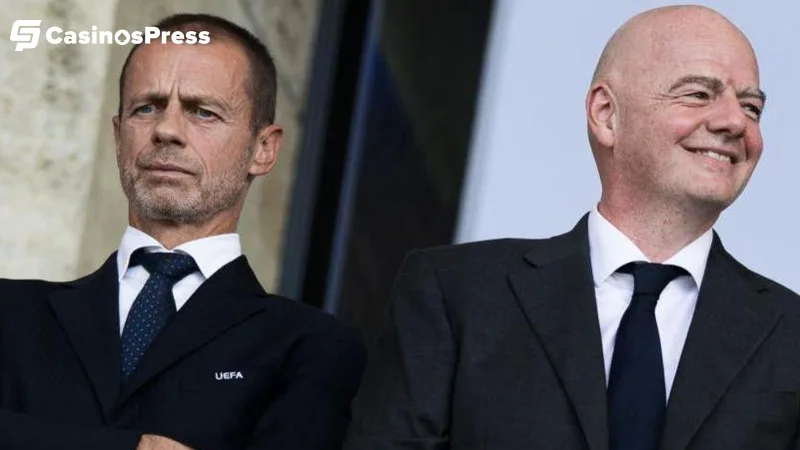
Uefa has threatened to pull its 55 national associations out of all Fifa competitions. That means no Europeans at the World Cup. No England, no France, no Germany, no Spain. The trigger is Fifa president Gianni Infantino's plan to sell a stake in a new subsidiary company designed to run Fifa's flagship competitions, funded in part by private investors with political connections. Uefa called it unacceptable and fired back with an eleven-word statement that shook the sport to its core.
So where does this leave us, and what does it mean for anyone with money on international football?
The Boycott Threat Is Real, But There's a Deadline
This isn't just noise. The September 19 deadline is the date by which national associations must accept Fifa's deal and access a $20 million payment. If that deal goes through, Uefa's boycott gets activated.
The immediate fallout would hit tournaments already in motion. The U20 Women's World Cup starts September 5 in Poland. European nations are in it. Under the current timeline, they could be pulled mid-tournament, before the semi-finals. After that come the Women's World Cup play-offs in October, featuring England, Scotland, Wales and Northern Ireland.
Wales qualifying for a Women's World Cup for the first time in history is on the line. You don't need to be a governance expert to understand why tempers are running this hot.
For bettors, the key point here is uncertainty. Markets hate uncertainty. Any odds tied to World Cup qualification, Women's World Cup play-offs, or even futures for the 2026 men's World Cup should be treated with extreme caution until this situation resolves.
Infantino's Position Is Weaker Than It Looks
Before this week, Infantino was expected to run unopposed for a fourth term in March. That picture has changed rapidly.
Concacaf, the confederation that actually hosted the most recent World Cup, has joined Uefa in rejecting the proposals. Their 41 members are either losing faith in Infantino or have already lost it. The Football Association in England and the Scottish FA have both come out firmly against him. These aren't fringe voices.
The repeated complaint is not just about the deal itself. It's about Infantino operating without consultation, without dialogue, and without bringing his own colleagues along. That kind of isolation at the top of a governing body is dangerous. Fifa's response, blaming media reports for disrupting consultation, hasn't helped his cause.
Historically, sitting Fifa presidents don't lose elections. The last one to fall at the ballot box was Sir Stanley Rous in 1974. But whispers about a challenger are growing louder. The name of Nasser Al-Khelaifi keeps surfacing, though sources close to him say he has no desire for the role. If a credible challenger does emerge, Infantino's position becomes genuinely fragile.
What a Schism Would Do to World Cup Value
Let's be blunt. A World Cup without Europe is a lesser product, commercially and competitively. In the last three major Fifa tournaments, European nations made up three of the four semi-finalists in each. Remove that and you're left with a competition that would struggle to justify the commercial figures Infantino has been promising to national associations.
The $40 billion product he described in letters to member associations becomes a fantasy without European participation. Broadcasters, sponsors and betting operators all price in European presence when they model tournament value. Strip that out and every commercial assumption falls apart.
For bettors specifically, think about what this means for futures markets on the 2026 World Cup. Brazil, Argentina and the CONMEBOL nations would become overwhelming favourites overnight if Europe withdrew. The value in those markets would collapse. At the same time, there's an argument that markets haven't fully priced in even the possibility of disruption yet.
Our Read on Where This Ends
Infantino backs down. That's our call.
The alternative is a full-scale split that destroys the commercial value of every Fifa competition and ends his presidency in disgrace rather than political defeat. Nobody, including Infantino, wins in that scenario.
The most likely outcome is that the deal gets restructured or quietly shelved, Infantino absorbs the reputational damage, and football returns to its usual uncomfortable standoff between the confederations and Fifa. Whether he survives the March election is a separate question, and genuinely more open than it was a week ago.
For now, we'd avoid placing any significant bets on Women's World Cup play-off outcomes or qualification markets until the September 19 deadline passes. The World Cup remains the biggest prize in football, and that's exactly why neither side can afford to let this go all the way.
Editorial Note: Marcus Osei
Senior football writer and tactical analyst with 12+ years covering the Premier League, Champions League, and world football. Born in Accra, raised between London and Kuala Lumpur.