
Argentina Broke English Hearts Again, Then Made It Political


Real Madrid loanee scores first career hat-trick in stunning Lyon debut
England were 35 minutes from a World Cup final. Then Argentina happened. Again.
The semi-final in Atlanta on 15 July had everything you could want from a fixture that carries more baggage than almost any other in world football. A tense game, a late collapse, a political flashpoint, and another chapter in a rivalry that refuses to stay just about football.
England Were So Close It Hurts
Thomas Tuchel set England up to be hard to beat, and for most of the game it worked. Anthony Gordon's 55th-minute finish put England ahead, and with the side sitting deep and disciplined, a World Cup final against Spain looked like a real possibility.
Then the 85th minute arrived. Then the 92nd. Argentina scored twice in the final seven minutes to win 2-1 and end England's best chance of reaching a World Cup final since 1966.
For England Men supporters, this one will linger. Not because of a bad performance, but because they were so close and it slipped away in the cruelest fashion. A 35-minute lead and nothing to show for it. That's the kind of result that defines a tournament, and unfortunately for England, it defined this one in the worst way.
Forty Years and Nothing Changes
The timing of this fixture carries enormous weight. Argentina's previous famous World Cup win over England came in the 1986 quarter-final, one of the most controversial games in the sport's history. Forty years later, in 2026, they've done it again in the semi-finals.
Argentina have now declared 15 July a 'National Football Teams Day' to mark the occasion. That tells you everything about how much this result means to them. For England, it's another date to file away in the growing list of near-misses.
The football itself was good enough to stand on its own as a major story. But Argentina's players made sure the conversation went well beyond the result.
The Banner That Changed the Conversation
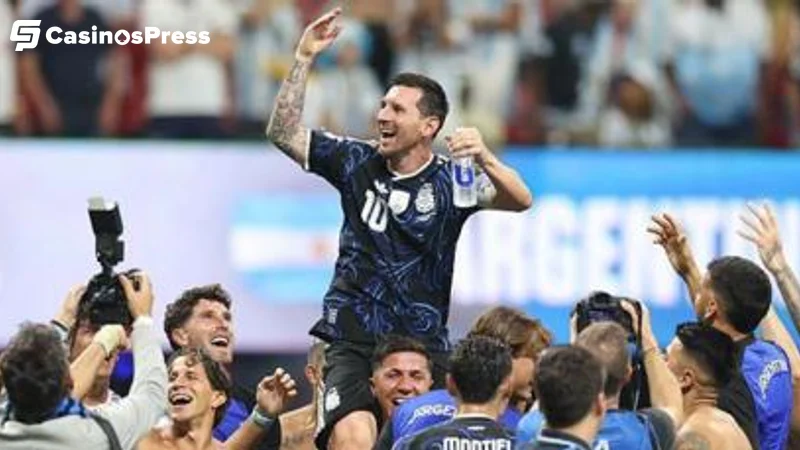
After the final whistle, some Argentina players celebrated while holding a banner reading 'Las Malvinas son Argentinas', which translates as 'The Falklands are Argentine'. In an instant, the match became about much more than football.
The Falkland Islands remain a British Overseas Territory. The 1982 conflict between Argentina and the UK lasted 74 days and cost the lives of 655 Argentine and 255 British servicemen. In a 2013 referendum, 99.8% of Falkland Islanders voted to remain part of the UK. The sovereignty dispute hasn't gone away, and some of Argentina's players clearly wanted to use this platform to make that point.
Whether you see it as a political statement, a provocation, or both, it guaranteed that this semi-final would be remembered for reasons that go far beyond what happened on the pitch. England Men fans had barely processed the late defeat before the footage of that banner was everywhere.
Where Both Teams Ended Up
Argentina's run didn't end in glory either. They lost 1-0 to Spain in the final, meaning the semi-final win over England was the peak of their tournament. There's a certain irony in that. The result that hurt England most also turned out to be as far as Argentina got.
England Men recovered enough to beat France 6-4 in the third-place play-off, which is a result worth acknowledging. A 6-4 win over France in a World Cup bronze medal match is no small thing, and it shows the squad had quality throughout. Third place at a World Cup is still a genuine achievement, even if it feels hollow when you were 35 minutes from the final.
This one will be debated for years. The football was gripping, the drama was real, and the politics made sure it couldn't stay in the sports pages. England came closer than they have in decades, and Argentina made sure everyone knew about it in every way they possibly could.
Editorial Note: Marcus Osei
Senior football writer and tactical analyst with 12+ years covering the Premier League, Champions League, and world football. Born in Accra, raised between London and Kuala Lumpur.