
From World Cup Heroics to Big Money Moves: The Players Who Cashed In


Real Madrid loanee scores first career hat-trick in stunning Lyon debut
The World Cup doesn't just decide which nation lifts the trophy. It reshapes careers, inflates market values and gives clubs around the world a live scouting report on players they'd never have considered otherwise. It's the ultimate shop window, and the smartest clubs know exactly when to buy.
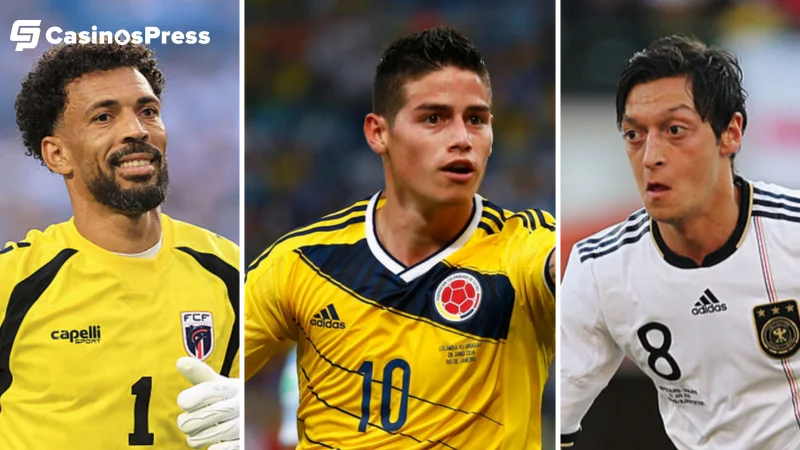
Vozinha's move to Colo-Colo after his heroics with Cape Verde at the 2026 World Cup is only the latest example. A 40-year-old goalkeeper playing in the Portuguese second division is now at the biggest club in Chile. If that doesn't prove the World Cup still has the power to rewrite a player's story, nothing will.
We've looked back at the players whose World Cup performances triggered career-defining transfers, and what those moves tell us about how clubs actually make decisions.
The Unknown Who Became a Champion
Gilberto Silva is the cleanest case study in World Cup value creation. Before 2002, he was a solid midfielder in the Brazilian top flight with Atletico Mineiro. After six weeks in South Korea and Japan, he was a World Cup winner who'd played every single minute of Brazil's triumphant campaign.
He only got his chance because captain Emerson got injured in training. Football works like that sometimes. But Silva grabbed it, kept it simple and made himself impossible to ignore. Arsenal paid around £4.5m for him. Eighteen months later he was a Premier League title winner in one of the most famous unbeaten seasons the game has ever seen. The Invincibles. That's what a well-timed World Cup can do.
When One Tournament Changes Everything
James Rodriguez in 2014 might be the definitive modern version of this story. Six goals, the Golden Boot and a volley against Uruguay that had people rewinding clips for years. Real Madrid signed him from Monaco for around 75 million euros before the tournament was even cold.
Mesut Ozil did it four years earlier. Four goals, four assists, Germany finishing third, and by August 2010 he was at Real Madrid for around 15 million euros. Three years on, Arsenal broke their transfer record to sign him for £42.4m. His value had essentially tripled off the back of one tournament.
The pattern is clear. A strong World Cup doesn't just attract interest, it moves the price up fast.
Mascherano, Foe and the Ones Who Came From Nowhere
Javier Mascherano arrived at the 2006 World Cup as a 22-year-old playing in Brazil. He left it as one of the most sought-after defensive midfielders in Europe. The move to West Ham was a stepping stone, but it led to Liverpool, then Barcelona, two Champions League titles and five La Liga medals. That's a career built on the back of one standout tournament.
Marc-Vivien Foe's story predates most of these but it deserves its place. An unknown at the 1994 World Cup in the USA, he caught the eye despite Cameroon's disappointing campaign. One strong game against Brazil was enough to earn him a free transfer to Lens, where he went on to win their first ever league title. He later played for West Ham, Manchester City and Lyon before his tragic death in 2003. His story reminds us that the World Cup has always had this power.
What This Means for the Betting Market
If you follow football betting, the World Cup transfer window is worth paying attention to. The clubs who move quickly after the tournament, the ones who had scouts watching the group stage closely, tend to get the best deals. By the time a player wins the Golden Boot the price has already gone up.
We've seen it with Enzo Fernandez, who moved from Benfica to Chelsea for a British transfer record after his 2022 winner's medal. We've seen it with Alexis Sanchez going from Udinese to Barcelona after 2010. Enner Valencia, Keylor Navas, Nicolas Otamendi. The list goes on.
For anyone who follows transfer betting markets or next club specials, tracking the standout performers in the group stage before the big clubs officially declare interest is where the value sits. By the quarter-finals, the odds on the big moves have usually already shortened.
Our Take
The World Cup remains the single most powerful force in the transfer market. One tournament can add tens of millions to a player's value or, in Vozinha's case, take a 40-year-old from the Portuguese second division to the most successful club in Chilean football history. Clubs that ignore it are leaving decisions to chance. The ones paying attention are often the ones who end up with the best business.
The 2026 tournament will produce its own version of these stories. The smart money is already watching.
Editorial Note: Marcus Osei
Senior football writer and tactical analyst with 12+ years covering the Premier League, Champions League, and world football. Born in Accra, raised between London and Kuala Lumpur.