
Argentina’s World Cup Chaos Could Have Lasting Consequences Beyond the Pitch


Real Madrid loanee scores first career hat-trick in stunning Lyon debut
Argentina arrived at World Cup 2026 as one of the tournament's most watched sides. They left it under a cloud that is only getting darker. FIFA has now opened formal disciplinary proceedings against multiple Argentina players, backroom staff, and the Argentine Football Association itself, covering everything from alleged assault to discriminatory chanting. This is a big deal, and it deserves more than a surface-level read.
What Actually Happened After the Final Whistle
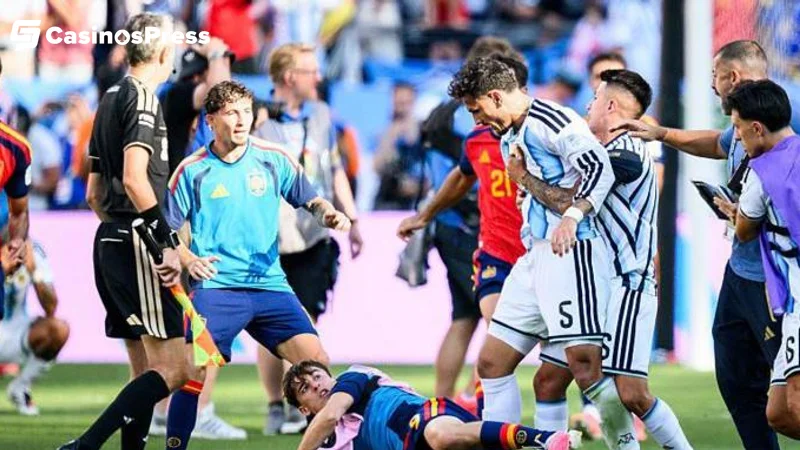
The scenes after Argentina's 1-0 loss to Spain in the final at the New York New Jersey Stadium were ugly. Multiple players and staff members were involved in altercations with Spain players, and FIFA moved quickly to appoint a disciplinary and ethics prosecutor to assess the fallout.
Nahuel Molina is facing two counts under investigation, with an additional charge of alleged unsporting behaviour. Leandro Paredes faces three counts. Assistant coach Roberto Ayala, a name older fans will remember well from his playing days, is facing one count. Under FIFA's disciplinary code, assault carries a minimum three-match ban. That means Molina and Paredes are both looking at real suspensions if found guilty, suspensions that would bite into the next competitive cycle.
Spain's Gavi and Argentina's Thiago Almada are also being investigated for unsporting behaviour, which shows this wasn't entirely one-sided. But the bulk of the charges sit with Argentina, and that's where the story lies.
The AFA Is in Serious Trouble
The individual charges are one thing. The charges against the Argentine Football Association are another matter entirely.
FIFA is investigating the AFA across multiple articles of its disciplinary code. That includes using a sporting event for non-sporting demonstrations, team misconduct, discrimination and racist abuse, and breaching order and security. Each of those categories covers a different type of incident across different matches during the tournament.
The Falklands banner after the semi-final win over England was the most politically loaded moment. Players celebrated by displaying a banner reading 'Las Malvinas son Argentinas' in front of the world's cameras. That's the kind of image that travels fast and lands hard. FIFA's rule on using sporting events for non-sporting demonstrations exists precisely for moments like that one.
The discrimination and racist abuse charges relate to chants and gestures from both players and supporters across the tournament. Argentina have faced this criticism before, and the fact that it keeps surfacing at major tournaments suggests the federation hasn't done enough to address it.
Where Does This Leave Argentina Going Forward
In terms of the 2026 World Cup itself, the title is gone and Spain are champions. But the consequences of these proceedings stretch well beyond one tournament.
If the AFA is found guilty across multiple articles, the sanctions could range from fines to points deductions in future competitions, or even partial stadium bans for supporters. We've seen UEFA apply those kinds of punishments in club football, and FIFA can go down the same road.
For the players involved, Molina and Paredes will both be hoping the investigations don't result in bans that affect their availability for World Cup qualifying. South American qualification for the 2030 World Cup is always brutal, and missing matches through suspension is a serious disadvantage.
The wider reputational question for Argentina football is harder to quantify. This is a national team that won the 2022 World Cup with enormous global goodwill behind them. Since then, the image has taken hits. On-pitch behaviour, political gestures, discriminatory chanting from stands, and now a brawl at a World Cup final. The shine has come off.
Our View on Where This Is Heading
FIFA tends to move slowly on these things but it does move. We'd expect Molina and Paredes to receive bans, with Molina's case looking more serious given the volume of charges stacked against him. Ayala's involvement as a member of the coaching staff adds another layer of seriousness because it signals to FIFA that the culture within the squad's backroom wasn't being managed.
For the AFA, a heavy fine seems the most likely outcome alongside a formal warning. A points deduction or competition ban is possible but would be a significant escalation. Given how politically sensitive South American football governance is, we'd put that at the lower end of probability.
What's clear is that Argentina's World Cup 2026 story didn't end when the final whistle blew. It's still being written, just in disciplinary hearing rooms rather than on a football pitch.
Editorial Note: Marcus Osei
Senior football writer and tactical analyst with 12+ years covering the Premier League, Champions League, and world football. Born in Accra, raised between London and Kuala Lumpur.