
Infantino’s Fifa Crisis: What It Means for Football’s Future and the Bets You Can Already Make


Real Madrid loanee scores first career hat-trick in stunning Lyon debut
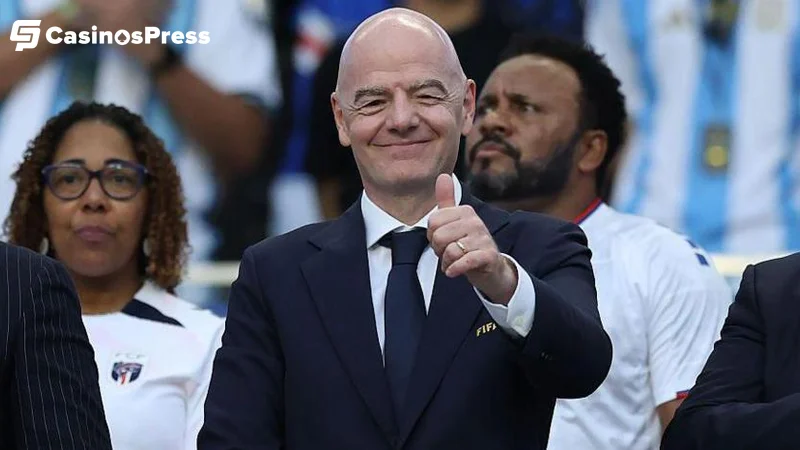
Gianni Infantino is fighting for his political life. The Fifa president called an emergency meeting with senior executives in Morocco this week, and the football world is watching to see whether he emerges with his position intact or whether the walls are finally closing in.
For football fans and bettors alike, this is a story worth following closely. The fallout from this crisis won't just reshape who runs Fifa. It could ripple into decisions that affect competitions, commercial deals, and the entire landscape of world football.
How Did It Get This Bad This Fast
The spark was Infantino's proposal to sell off a chunk of Fifa's commercial and event operations to private investors. The plan was scrapped, but the damage it caused is still spreading.
His own secretary general called it 'a sad and reproachable series of events.' His chief operating officer said the Fifa administration had been 'deceived.' His senior adviser on global strategy quit, calling it 'a bad deal for football.' These are not minor critics from the outside. These are the people who sit inside Fifa's inner circle.
Arsenal legend and Fifa's chief of global football development Arsene Wenger distanced himself publicly, saying he was 'not involved' and that scrapping the plan was 'absolutely necessary.' When Wenger is putting out statements to separate himself from your idea, you know the project is toxic.
The criticism from Europe has been especially fierce, with Uefa saying it has lost confidence in Infantino's leadership. Several associations including Wales have pulled their support for his re-election, with England expected to follow.
The Morocco Calculation
Infantino chose to hold the meeting at Fifa's Africa office in Rabat, and that choice says everything about his current strategy. Morocco is hosting the next World Cup, so their association is naturally supportive. Several African nations including Egypt and DR Congo have already issued backing statements this week.
The game plan seems clear. Consolidate support in Africa and parts of South America and Asia, weather the European storm, and try to arrive at the March congress with enough votes to survive.
We've seen this playbook before. Sepp Blatter was re-elected as Fifa president in 2015 even while the corruption scandal was detonating around him. He resigned eight days later, but he still won the vote. The point is that European outrage does not automatically translate into a Fifa majority. Infantino knows this. That's why he's fighting.
The Road to Removal Is Longer Than It Looks
For anyone hoping this ends quickly, the mechanics of removing a Fifa president are genuinely complicated.
Uefa has 55 member associations, which means it can technically trigger an extraordinary congress on its own. But triggering one doesn't guarantee winning one. You'd need 106 votes to pass a no-confidence motion, and Infantino would have weeks or months to lobby for support while the process plays out. That's a long time in football politics.
The other route is through the Fifa Council, but getting 19 of the 37 council members to call an emergency meeting is reportedly difficult to achieve right now.
Then there's the election route. The deadline to declare candidacy for the March congress is 18 November. Concacaf president Victor Montagliani has been floated as a potential unity candidate, but no confirmed challenger has emerged yet. Without a credible alternative, even disillusioned associations might stick with the devil they know.
Infantino has been here before, at least in terms of controversy. He always finds a way to keep going.
What This Means for Football's Bigger Picture
For the betting angle, it's worth thinking about what each outcome actually changes.
If Infantino survives and reforms Fifa's governance, you'd expect the 2026 World Cup and 2030 World Cup projects to roll on without major disruption. His controversial 64-team World Cup expansion could remain on the table depending on how many concessions he offers to buy back support.
If he's forced out, a new president would almost certainly slow down or reverse some of his more ambitious commercial expansions. That could affect everything from Club World Cup prize money to how broadcasting deals are structured over the next decade.
These aren't just political questions. They're commercial ones that feed into transfer markets, club revenues, and ultimately the quality of football we watch.
Our read on this is straightforward. Infantino won't resign this week. He'll offer something that looks like contrition, promise reform, and use the next few months to shore up his base outside Europe. Whether that's enough to get him to March as a candidate, let alone past it, is genuinely uncertain.
But if you're the type who likes to watch football politics as closely as the football itself, this one is far from over.
Editorial Note: Marcus Osei
Senior football writer and tactical analyst with 12+ years covering the Premier League, Champions League, and world football. Born in Accra, raised between London and Kuala Lumpur.