
Messi at the Crossroads: What Retirement Would Mean for Football and the Bets We’d Never See Again


Real Madrid loanee scores first career hat-trick in stunning Lyon debut
Football doesn't do moments like Messi anymore. It never really did.
The news that Lionel Messi is seriously considering retirement after the death of his father Jorge has hit the football world hard. And while the emotional weight of that is obvious, there's a sporting question underneath it that fans and bettors alike are already wrestling with: what does the game actually look like without him?
We think it's worth taking stock. Not just of the records, but of what made Messi the kind of player who changed what football could be.
The Moment a Teenager Became Inevitable
March 2007 is where most neutral fans finally accepted what was coming. A 19-year-old Messi scored a hat-trick in El Clasico, including a last-minute finish that left the Camp Nou stunned. It wasn't just the goals. It was how relaxed he looked doing it against the biggest rival in the sport.
Then came the Getafe goal a month later. Picking the ball up in his own half, beating five defenders, rounding the keeper and finishing. If you were betting on who would define the next decade of football that night, you'd have cashed out extremely well.
Those two moments in spring 2007 didn't just announce Messi. They set the terms of every football debate for the next 18 years.
A Career Built on Moments That Shouldn't Have Been Possible
91 goals in a calendar year. Not a season. A year. It's the kind of stat you read twice because it doesn't seem real, and yet it happened in 2012 across just 69 appearances for club and country.
That same year he broke Barcelona's all-time scoring record at 24. He eventually left with 672 goals for the club. To put that in perspective, he scored more goals for Barcelona than most top European forwards score in their entire careers for all clubs combined.
In the Champions League he finished as the second highest scorer in history with 129 goals, behind only Ronaldo. His four-goal display against Arsenal in 2010 remains one of the great individual European performances, and his goals in two Champions League finals against Manchester United proved he could do it on the very biggest nights in club football.
For bettors who followed him through that Barcelona era, there was no more reliable match-winner in the world. Any accumulator that included Messi scoring or assisting felt like a safe anchor.
The Argentina Question That Finally Got Answered
The one thing held against Messi for years was the international trophy cabinet. Critics used it as the dent in his legacy, the reason the greatest footballer debate stayed open.
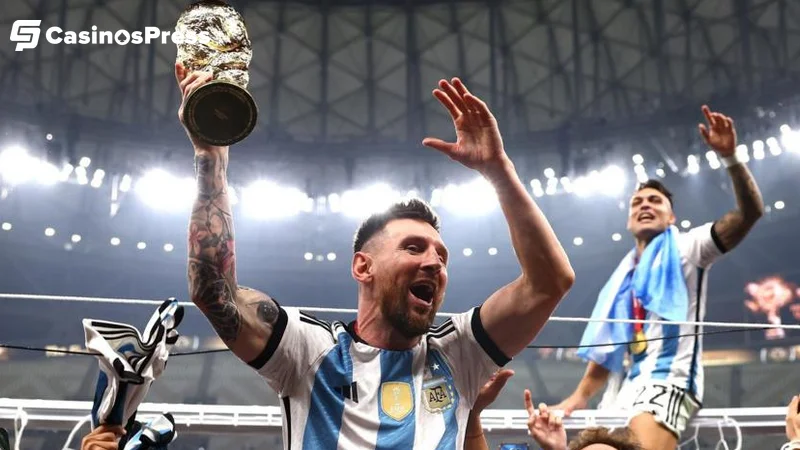
He answered it in 2021 with the Copa America, then won it again three years later. But the definitive reply came in Qatar in 2022. Seven goals, including efforts in every knockout round, a stunning individual display in a 3-3 final against France, and then a penalty shootout to win the World Cup.
He was named player of the tournament. It was the clearest possible statement that no argument about his greatness had any ground left to stand on.
At the 2026 World Cup, aged 39, he scored eight goals to take his all-time tally to 21, briefly making him the tournament's record scorer before Mbappe passed him. Argentina lost to Spain in the final, but Messi's contribution was once again extraordinary. Very few players at 39 are still relevant at a World Cup. Messi was arguably still the focal point of an entire nation's hope.
What Football Loses If He Walks Away
In football terms, the answer is simple. It loses its compass.
Messi was always the reference point. When a young player emerged, the first question was always how they compared. When a goal was scored, the standard was always whether it reached the level he set. Eight Ballon d'Or wins, 921 career goals across Barcelona, PSG, Inter Miami and Argentina, and a World Cup medal that finally silenced every doubt.
From a football perspective, there's no immediate replacement. There are brilliant players. There are players who will have historic careers. But the combination of longevity, consistency, and the ability to produce decisive moments in the biggest games is something we won't see replicated easily.
If Messi does retire, football won't stop. The next generation will take over and the debates will shift. But the sport will be measurably smaller for his absence, and anyone who watched him at his peak knows exactly what we mean by that.
Editorial Note: Marcus Osei
Senior football writer and tactical analyst with 12+ years covering the Premier League, Champions League, and world football. Born in Accra, raised between London and Kuala Lumpur.