
The Hand of God Ball Sold for £2.5m, But Was It Worth More?


Real Madrid loanee scores first career hat-trick in stunning Lyon debut
The most notorious handball in football history just changed hands again, and the price tag raised more eyebrows than the original incident ever did.
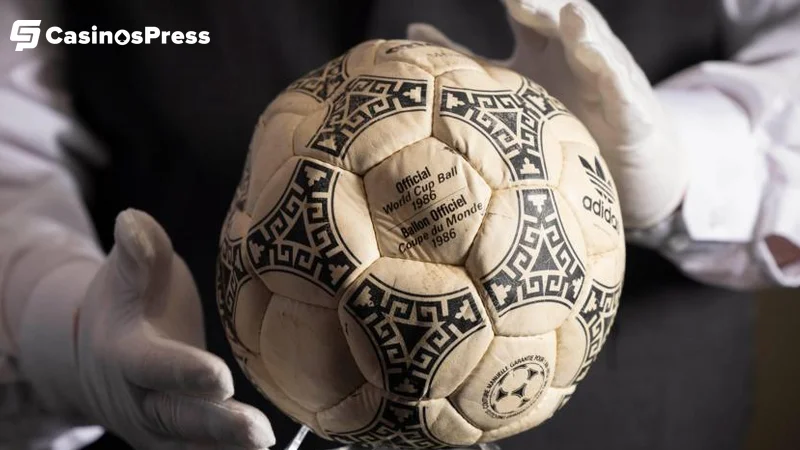
Diego Maradona's 'Hand of God' ball from the 1986 World Cup quarter-final between Argentina and England sold at auction in the United States for £2.5m. Significant money by most measures. But here's the thing: it was expected to fetch closer to £7.3m. That's a gap so large it tells its own story.
The Most Famous Football Ever Kicked, Or Punched
Let's set the scene. Mexico, June 1986. Argentina versus England in the World Cup quarter-final. Maradona rises, extends his left fist, and bundles the ball past Peter Shilton. The referee, Tunisian Ali Bin Nasser, misses it completely and the goal stands.
Maradona described it afterwards as scored 'a little with the head of Maradona and a little with the hand of God.' One of the most brazen post-match quotes in sporting history. Minutes later, in the same game, he then produced what became known as the goal of the century, weaving past five England outfield players before slotting home. Two goals, one match, two completely opposite ends of the sporting spectrum. Genius and controversy wrapped up in 90 minutes.
The ball at the centre of it all sat with Bin Nasser for over three decades. He collected it at full-time and held onto it quietly until 2022, when he sold it for $2.37m. Its new owner put it up for auction in 2023, but bids didn't reach the reserve and it went unsold. Second time around, it finally crossed the line at £2.5m.
Why Did It Fall So Short of Expectations?
This is the question worth asking. We're talking about what one auctioneer described as arguably the most significant football item that exists. A true one-of-one. Authenticated by independent experts and confirmed in writing by the referee himself. It doesn't get more verified than that.
And yet it sold for roughly a third of what it was expected to make.
Compare it to Maradona's shirt from the exact same match, which went for £7.1m in 2022. A shirt. From the same game. More than double the price of the actual ball. That tells you something about how the memorabilia market works, and where football collector sentiment currently sits.
Our read on it is simple. The shirt is wearable, displayable, photogenic. People connect with it visually. A football, even the most famous one ever used, is harder to present, harder to store and arguably less striking on a wall. The emotional connection isn't quite the same even when the historical value absolutely is.
There's also the question of repeated exposure. This ball was offered at auction in 2023 without selling. Once a lot fails to shift, it creates doubt in buyers' minds. The magic fades slightly. Bidders wonder why no one else wanted it last time, even if the reasons were purely technical.
What the Memorabilia Market Tells Us
Sports memorabilia has been on a rollercoaster over the last few years. The pandemic created a boom as collectors sat at home with money to spend and nowhere to go. That bubble has deflated somewhat, and big-ticket items are now finding it harder to hit ambitious estimates.
The football market specifically is also younger in collector terms compared to American sports like baseball and basketball, where memorabilia culture is deeply embedded. A £2.5m sale is enormous in the context of most football auctions, but relative to the historical weight of this specific item, it reads as an underperformance.
For anyone thinking about sports memorabilia as an investment, this auction is a useful case study. Provenance alone doesn't guarantee return. Market timing matters. Presentation matters. And the difference between a shirt and a ball, apparently, is about £4.6m.
Our Take
The Hand of God ball deserved better. In terms of historical weight, cultural significance and sheer footballing drama, there is almost nothing else like it. It was used in a match containing both the greatest individual goal ever scored and one of the most debated moments in World Cup history. The fact it sold below a third of its estimate says more about market conditions and auction fatigue than it does about the object itself.
If you believe sports memorabilia finds its true value over time, the buyer at £2.5m might look very smart indeed in ten years. Or the market stays soft and they're stuck with a football on their mantelpiece. Either way, it's a better conversation starter than most things money can buy.
Editorial Note: Marcus Osei
Senior football writer and tactical analyst with 12+ years covering the Premier League, Champions League, and world football. Born in Accra, raised between London and Kuala Lumpur.