
VAR Is Broken and UEFA Knows It: What the Rosetti Reset Means for Bettors


Real Madrid loanee scores first career hat-trick in stunning Lyon debut
VAR was supposed to kill controversy in football. Instead, it created a whole new kind of it. Now UEFA's own referees' chief is admitting the system has drifted too far from what the game actually needs, and for anyone betting on football, that shift matters more than most people realise.
The Problem UEFA Finally Put Into Words
Roberto Rosetti, the man in charge of referees across UEFA competitions, has come out and said it plainly. Some VAR reviews were not connected with football. Not connected with football. That's a damning line from the man running the system.
The concern isn't just philosophical. Rosetti pointed to reviews running longer than 90 seconds as damaging to credibility, players gaming the system to earn video decisions, and a growing disconnect between what happens on the pitch and what gets decided in a studio. His words confirm what football fans have felt for years. VAR stopped being a safety net and became the main event.
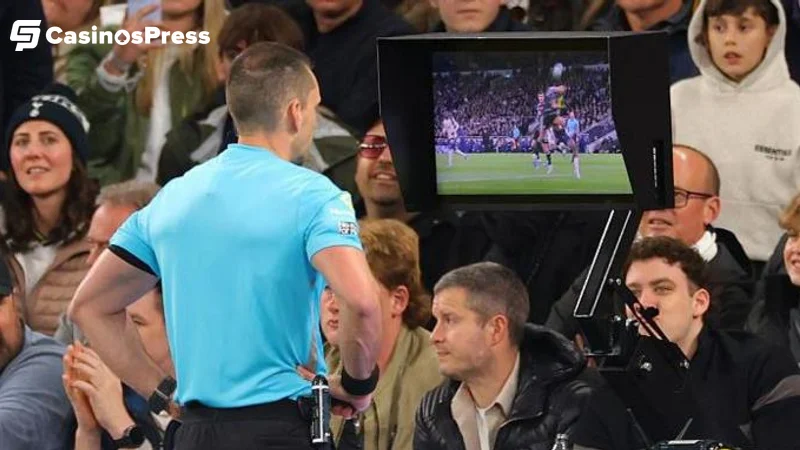
The new collective protocol agreed between UEFA and the top five European leagues introduces a cleaner review process. When a referee goes to the monitor, they see a freeze-frame at point of contact, then half speed, then full speed for the intensity of a challenge. No endless replays. No zoomed-in freeze frames finding marginal contact. The aim is to put referees back at the centre and limit VAR to genuinely clear and obvious mistakes.
What the Numbers Tell Us About Handball and Penalties
Here's where it gets really interesting for football bettors. The gap in handball interpretation across Europe has been enormous, and the data exposes just how inconsistent things have been.
In the Premier League last season, a handball penalty was awarded roughly once every 17 games. In Ligue 1, it was once every 9 games. The Champions League sat at once every 7 games, the most frequent rate on the continent. That's not a small gap in interpretation. That's a completely different game depending on which competition you're watching.
For anyone betting on both/teams to score, Asian handicaps or match totals, the penalty frequency data is genuinely useful context. A Champions League night between continental sides was statistically far more likely to produce a penalty than a Premier League fixture. If the new protocol tightens up handball decisions and pushes intervention rates down, that dynamic changes.
The Premier League already had the lowest VAR intervention rate in Europe at 0.29 per game. The Champions League sat at 0.47. If UEFA is pushing all competitions toward a more restrained standard, expect that Champions League number to fall, and with it, some of the penalty-related value that crept into the odds.
The Player Behaviour Angle Nobody Talks About
Rosetti flagged something that doesn't get nearly enough attention. VAR has changed how players behave in real time. They now play for reviews. Defenders wrap arms around attackers in the box knowing a freeze-frame could catch it. Attackers fall or flail to manufacture contact that looks worse in slow motion than it felt in the moment.
If the new protocol works as intended and referees are no longer scrutinising microscopic contact through multiple slow-motion replays, that gamesmanship loses its value. Players will adapt. And when they do, we should see fewer soft penalties, fewer red cards from marginal second-yellow decisions, and more matches finishing with the result the 90-minute flow suggested.
For in-play bettors especially, this is worth watching closely. A game that might have been levelled by a VAR-awarded spot kick in the 88th minute last season might just finish the way the teams played it. That's a meaningful shift if you're trading match odds live.
Our Read on What Changes
We think this reform matters, but it won't flip everything overnight. Referees across different leagues have spent years operating under their own interpretations of the same laws. Getting to a genuinely uniform standard takes more than a new protocol and a video library.
In the short term, watch for a drop in penalty frequency in the Champions League. Watch for quicker reviews that don't overturn on-field calls unless the error is obvious. And watch for matches to feel more like football again rather than a sequence of stops and reviews.
If you're building accumulators around matches in European competition, factoring in that the penalty landscape is actively shifting is smart. The odds market hasn't fully priced in what a lower intervention rate does to over/under lines, anytime scorer bets and team total goals.
Rosetti is right that football isn't PlayStation. The question now is whether the referees, the clubs and the players actually buy into the reset. We're cautiously optimistic, but we've been burned by VAR promises before.
Editorial Note: Marcus Osei
Senior football writer and tactical analyst with 12+ years covering the Premier League, Champions League, and world football. Born in Accra, raised between London and Kuala Lumpur.