
From the Pitch to the Boardroom: Why Premier League Players Are Getting Business Degrees


Real Madrid loanee scores first career hat-trick in stunning Lyon debut
Football has a reputation problem when it comes to player intelligence. The lazy assumption is that elite footballers are one-dimensional, laser-focused on the ball and nothing else. A growing group of Premier League players is quietly dismantling that idea, one postgraduate diploma at a time.
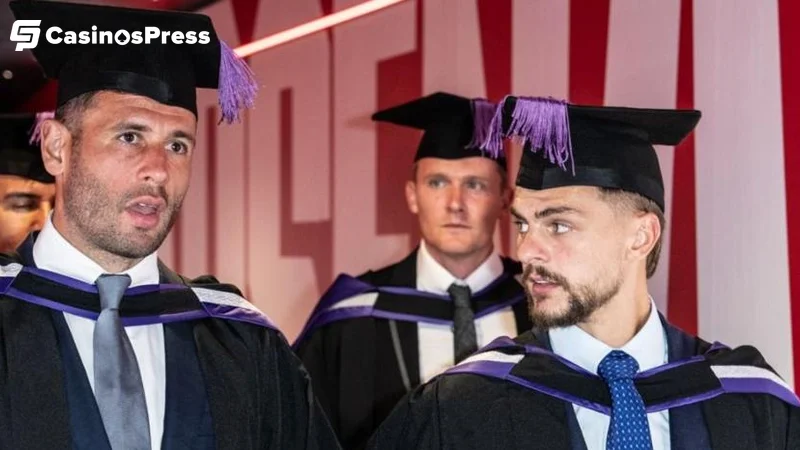
The PFA Business School has been running long enough to produce a proper graduating cohort, and its 2026 ceremony, held at Arsenal's Emirates Stadium of all places, brought together current players and former stars to celebrate exactly that. Caps, gowns, the lot. The kind of scene you'd expect at a university campus, not a football ground.
The Players Behind the Diplomas
The names involved give this real weight. Everton midfielder Kiernan Dewsbury-Hall, still just 28 and arguably playing the best football of his career, has completed a postgraduate diploma in global football sport directorship. He took the train down from Merseyside specifically for the ceremony. Taiwo Awoniyi, the Coventry City striker who has had a genuinely difficult couple of years, is also among the graduates. For Awoniyi, this is his third qualification alongside a degree in business management and a previous diploma.
Then there's Cesar Azpilicueta, who adds serious credibility to the whole thing. A Champions League winner and former Chelsea captain who completed an MBA at Harvard during his time in west London, he told the group how he used his studies to settle his nerves on the morning of the 2021 Champions League final. Chelsea beat Manchester City 1-0 in Porto that evening. Whatever he was doing that morning, it worked.
Wycombe Wanderers defender Steve Cook, who captained Bournemouth in the Premier League, also graduated. For him it was a return to formal education for the first time since school. Different stories, different motivations, same outcome.
What a Sporting Directorship Diploma Actually Means
The course is built to work around a playing career. Seminars are scheduled to avoid clashes with matches and training, and players can study in their own time. Dewsbury-Hall admitted getting a few strange looks while revising on his iPad on the way home from away games. Honestly, fair enough.
The content is serious though. Sessions with figures like Brighton chief executive Paul Barber are designed to give players a real understanding of how football clubs are run from top to bottom. Governance, recruitment, commercial strategy, all the things that sit behind the ninety minutes on a Saturday.
For a player like Dewsbury-Hall, who has come through Leicester and Chelsea before landing at Everton, understanding that side of the game could be genuinely useful when his playing days end. He's not setting up a second career right now. He's building the foundations while he still has the time and energy to do it properly.
Why This Matters for Football
Football in this country has a chronic problem with its coaching and director pipelines. The number of elite Black former players in senior football leadership roles, for instance, remains embarrassingly low. Initiatives like the PFA Business School won't fix structural problems overnight, but they do create a generation of players who understand the business before they're forced to figure it out in retirement.
Awoniyi's point about time is worth sitting with. He's right that footballers aren't working nine to five. There are evenings, mornings and long journeys home from away games. The players who use that time well are already thinking differently about life after the game.
Azpilicueta's framing is the sharpest of all though. He says it's not just about preparing for life after football, it's about becoming a better version of yourself while you're still playing. That's the mindset of someone who understands leadership, not just captaincy.
Our Take
The football world has always had smart people in it. What it hasn't always had is smart people who were encouraged to develop that side of themselves while still active. The PFA Business School changes that slightly, and the calibre of the graduates involved in this cohort suggests it's producing something real.
Dewsbury-Hall, Awoniyi and their classmates may not end up as sporting directors. Some will go into coaching, some into media, some into business entirely outside football. But the fact they've done this at all, while playing at a high level, while managing injuries and travel and performance pressure, tells you something about character that no transfer fee or expected goals number ever could.
The stereotype of the footballers who can't think beyond the next match is dying. This cohort is helping to bury it.
Editorial Note: Marcus Osei
Senior football writer and tactical analyst with 12+ years covering the Premier League, Champions League, and world football. Born in Accra, raised between London and Kuala Lumpur.