
Klopp’s Germany Era Begins: What His Squad Choices Tell Us About the Betting Value


Real Madrid loanee scores first career hat-trick in stunning Lyon debut
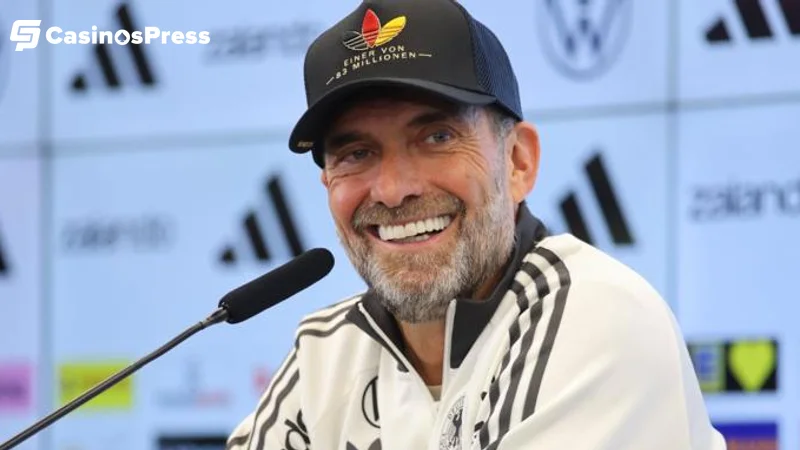
Jurgen Klopp is finally on the touchline as Germany manager. After weeks of headlines, press conferences and stadium visits, the football actually starts now. And for those of us who like to back our opinions with a bet, Klopp's first squads tell us a lot about what kind of team Germany is about to become.
Two Squads, One Very Clear Message
Klopp has done something genuinely unusual for his first international break. He has split Germany into two almost completely separate squads across four matches. The first group, featuring Joshua Kimmich, Kai Havertz and Jamal Musiala, faces the Netherlands and then hosts Greece. The second group, built around Florian Wirtz and Aleksandar Pavlovic, takes on Serbia and then faces Greece away.
Only one player appears in both squads. That is backup goalkeeper Finn Dahmen, which tells you everything about how seriously Klopp is treating this as a trial period rather than a points mission.
From a betting perspective, this matters. Germany's odds in either fixture reflect a nation with serious talent, but what we are actually getting in these games is closer to an experimental side than a settled one. That gap between perceived quality and actual lineup is where value hides.
The Klopp Blueprint and Why It Changes Everything
We know how Klopp builds a team. He does not simply plug in the biggest names and hope for the best. His track record shows a clear preference for players who buy into a high-energy, wing-focused system over those with pedigree but poor pressing habits.
His Germany sides will look to attack down the flanks, get men in behind, and win the ball high up the pitch. It worked with Mohamed Salah, Sadio Mane and Trent Alexander-Arnold at Liverpool, and the raw materials in this Germany squad are not far off. Said El Mala, Lennart Karl, Derry Scherhant and Kevin Schade all bring speed and directness in wide areas. Klopp clearly wants to run at teams rather than pass them into submission.
The contrast with Julian Nagelsmann's approach could not be sharper. Where Nagelsmann built complex tactical systems to paper over cracks, Klopp wants simplicity, tempo and intensity. In our view, that style tends to produce more goals, more momentum shifts, and more value on over markets in the early stages when opponents are not yet adjusted to the press.
The Unknowns Are the Interesting Part
Some of these Germany call-ups are remarkable in the truest sense of the word. Felix Keidel, a 23-year-old hybrid full-back from recently promoted SV Elversberg, was playing second division football not long ago. Bambase Conte, Mika Baur and Vitaly Janelt are names that casual Germany fans will not recognise at all.
Klopp has form here. He turned Lukasz Piszczek from an unknown into one of Europe's best right-backs. He helped Andy Robertson become a Champions League winner. He finds something in players others overlook, and then he builds a team identity around collective effort rather than individual brilliance.
For Germany, a nation that has looked stale and disconnected at recent tournaments, that identity reset could be the most important thing Klopp delivers. But it will not happen overnight, and that is worth keeping in mind when assessing Germany's short-term prices.
Our Read on the Betting Angle
Germany's squad for the Netherlands game carries genuine quality, but Klopp himself has said it could be 'wild' and unpredictable. That is not typical manager talk designed to lower expectations. He means it. The tactical shape is new, the combinations are untested, and several players are playing in a pressing system that differs from what they do week to week in the Bundesliga.
We would not be backing Germany to win both of their first fixtures at short prices. The value is elsewhere. Look at both teams to score markets, over 2.5 goals given Klopp's attacking intent, and keep an eye on individual player performance markets for the uncapped or newly capped names who will be desperate to impress.
Longer term, Germany under Klopp is a team we want to follow closely in the Nations League and heading into the next major tournament. The squad is young, averaging 24 to 25 years old across both groups, and the coaching pedigree is undeniable. Once the system clicks, Germany could drift in tournament markets before anyone notices how good they are becoming.
Right now though, this is still day one. And even Klopp said so himself.
Editorial Note: Marcus Osei
Senior football writer and tactical analyst with 12+ years covering the Premier League, Champions League, and world football. Born in Accra, raised between London and Kuala Lumpur.