
German Football’s Broken Pyramid: Why Champions Are Being Robbed of Promotion


Real Madrid loanee scores first career hat-trick in stunning Lyon debut
German football is in crisis at its foundations. Not in the Bundesliga, not in European competition, but deep in the fourth tier where a structural flaw has been quietly punishing clubs, fans and players for years. And right now, that frustration is boiling over.
The System That Punishes Success
Win your league and you go up. That's the basic contract football makes with every club that competes. In Germany's fourth tier, that contract is broken.
Below the Bundesliga, 2. Bundesliga and 3. Liga, the fourth tier is split into five regional leagues. Five champions. But only four promotion spots. One champion, every single season, gets left behind despite winning everything asked of them.
Lokomotive Leipzig know this pain better than anyone. Their captain Djamal Ziane has won the Regional League Northeast three times in seven seasons, most recently in back-to-back campaigns. Each time, instead of automatic promotion to the 3. Liga, they faced a play-off. Each time, they came up short. Ziane is 34 now. He may never get another shot.
It's hard to overstate how cruel that is. This isn't a cup exit or a near-miss in a title race. Lok Leipzig did what champions are supposed to do, twice in a row, and they're still in the fourth division.
The East-West Divide at the Heart of the Problem
The current setup hands automatic promotion to the champions of the West and Southwest leagues. A third spot rotates between the other three leagues on a three-year cycle. The fourth spot goes to a play-off between the remaining two.
The justification is population. More people live in the west, more clubs are registered there, so more weight is given to those leagues. It's logical on paper and completely unfair in practice.
What gets ignored is that the Regional League Northeast consistently draws the biggest crowds in German football's fourth tier. Lok Leipzig averaged over 6,300 fans per home game last season. A local derby against Chemie Leipzig pulled more than 11,000. For context, that average crowd figure across the Northeast was roughly double what the other regional leagues were pulling in.
The frustration connects to something bigger too. East Germany continues to lag behind the west economically. Wages are lower, populations are shrinking, young people move away, and corporate investment is almost non-existent in the former GDR. The football clubs from this region are fighting structural disadvantage at every level, and the promotion system reinforces rather than corrects that.
The Compass Model and the Vote That Went Wrong
A reform campaign has been gathering real momentum in German football. The proposal, backed by more than 80 clubs from across the country, is called the compass model. The idea is to reduce the five regional leagues to four, with boundaries redrawn each season using an algorithm that accounts for travel distances and local derbies. Every region gives up something. Every champion gets a fair shot at promotion.
The campaign has picked up some serious backing. Borussia Dortmund's president called for champions to go up and endorsed the compass model directly. Union Berlin officially backed it. Even Bournemouth manager Marco Rose, who has history with Lok Leipzig, came out in support.
A vote was held in June. It descended into farce. At the last minute, the regional federations running the ballot changed the rules, reducing proposed league sizes and requiring majority support within each individual region rather than across the overall vote. The compass model still got an overall majority, 50.9%, but it wasn't enough under the new terms. The Southwest backed a different plan. Bavaria voted for more talks. The whole thing collapsed.
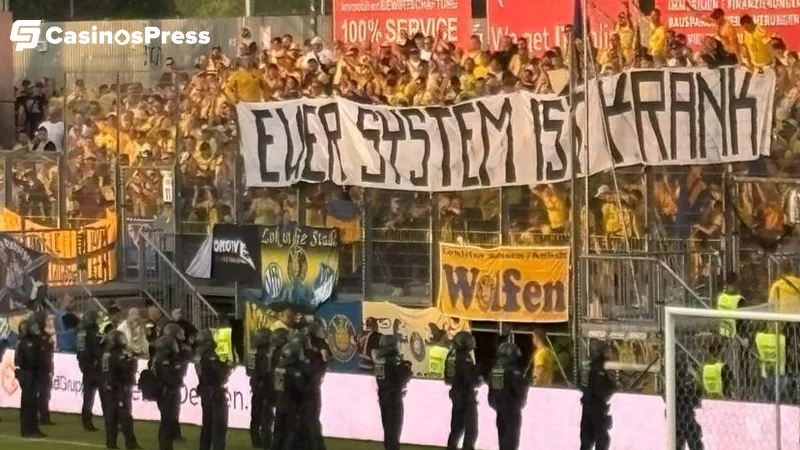
The backlash was immediate and loud. Players in the Regional League Northeast have been refusing to kick off for the first minute of every game as a protest. Lok Leipzig fans threw plastic trophies onto the pitch to symbolise what their titles are worth under this system. Bayern Munich's ultras turned up to a reserve game and produced a full choreography criticising the Bavarian Football Federation for blocking reform.
Where This Ends Up and Why It Matters for German Football
An extraordinary general meeting has been called for December, with the German Football Federation president saying publicly that the compass model offers the best path forward. It's the clearest signal yet that change is genuinely coming. Any reforms, though, won't be in place until 2028-29 at the earliest, which means at least two more seasons of the current broken system.
For Ziane and Lok Leipzig, that's likely too late. For German football more broadly, the whole story raises a question worth sitting with: what does it do to a sport when the basic principle of merit, win the league and earn promotion, stops being guaranteed?
Fans across the Bundesliga are already answering that question with banners and protests. The system is sick, as one banner in Leipzig put it. The December meeting is German football's chance to write a better prescription.
Editorial Note: Marcus Osei
Senior football writer and tactical analyst with 12+ years covering the Premier League, Champions League, and world football. Born in Accra, raised between London and Kuala Lumpur.